Friday, 16 November 2012

Santiago - November 12-16th

We got to Santiago in the evening and took a taxi to the Bellavista neighborhood to our hostel, also called Bellavista. Bellavista is the artist area of Santiago with lots of cool street art and also has two large universities. We didn't do much our first evening besides get settled in and go out for a quick dinner. There are lots of restaurants, bars and clubs around to choose from.

On our second day we spent the morning wandering around the neighborhood and hunting for a grocery store. We were very excited to get to make our own meals after 40 days of eating out three times a day. It should also be easier on the wallets! In the afternoon we navigated the subway, with only a little assistance needed from a kind stranger, and went to the Plaza de Armas (the big square near the centre of every big South American city). Here we met up with a free walking tour which was wonderful! For about two and half hours we walked around chatting with a big group of other backpackers. We saw everything from the downtown core (very similar to any large Canadian city, there is even Starbucks on the corners) to the historic area and the government buildings. The history of Chile was really interesting. We didn't realize it was only in the last 30 years that the country overcame its communist government that was really violent. Our guide told us that the oldest generation still harbors a lot of resentment but that the younger generations have moved on. By the end of the tour we had quite a few new friends and a bunch of us, including the guide, all met later at a bar near the hostel for some drinks.

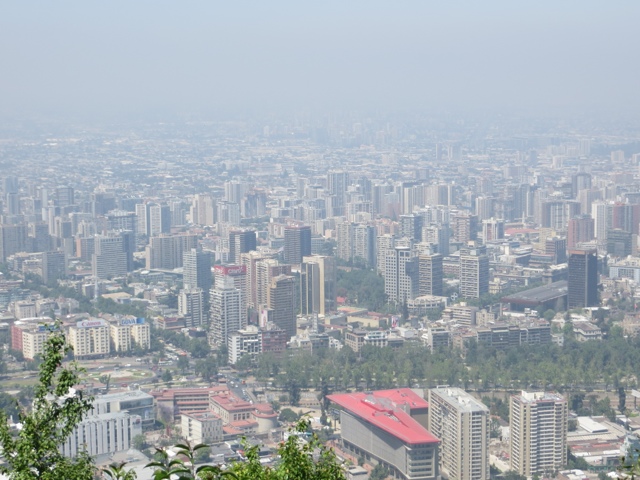
On our second full day we started out by going to San Cristobal hill that overlooks the city. We caught a free bus to the top and walked around for a bit. Unfortunately it was very smoggy out and we didn't get that good of a view. There is one tall tower that sticks out of the skyline (so we have been using it to orient ourselves) that was built by a communications company and is shaped like an (old-school) cellphone. At the bottom of the hill we visited the Santiago Zoo which was quite nice as far as zoos go. We did feel really bad for the polar bear though, if we were way too hot I can only imagine how he felt! In the afternoon we navigated the subway system again, all on our own this time, to the bus station and successfully bought our next four bus tickets. All together it was $100 US each which we thought was pretty good!

Today, our third day here, we did some shopping as we walked to the seafood and produce markets of Santiago. For lunch we had a Chilean speciality called Chorillana which is fries, sausage, sautéed onions, beef and an egg with sauce. Basically just a more extreme version of poutine! Which apparently is not popular around the world because none of the Australians or UK friends we tried to describe poutine to had heard of it. On our way back we browsed a craft market just as you enter Bellavista that is famous for its copper jewellery and jewellery with lapisazul stones. They are a really pretty blue stone that is only found in Chile and a handful of Middle Eastern countries. We also managed to find a pub that serves the infamous terramoto we had been told we have to try. Terramoto means earthquake and is the Chilean national drink. It's white wine, rum, grenadine and pineapple sherbet served in a big beer mug. Sounds weird, but they are delicious! You can also get aftershocks which are just a smaller version.

Santiago is a really cool, modern city thats fun to explore. We were really proud of ourselves for mastering the subway system and finding things to do on our own. It was nice to stay in a hostel and cook our own food. Every day more people come and go. We've met people from all over the world and its so cool to chat and share stories.

-Lisa

Pictures
1-Government Building
2-Smoggy Santiago
3-Even the streets are art-y in Bellavista!
3-Smoggy Santiago
4-wildlife at the zoo
5-(part of) the main Santiago bus terminal
6-the cellphone tower

Sunday, 11 November 2012

San Pedro de Atacama

Saturday, November 10th

So we arrived in San Pedro de Atacama pretty tired, now hot, hungry and thirsty, and craving a shower. As we walked through town with our big backpacks on trying to find a working ATM, the tourism office and a hostel to stay at, we finally got our first taste of true backpacking- exhilarating and also exhausting. We finally got cash out- Chilean pesos are about a 480 exchange rate with the USD- it's very confusing to pay in denominations in the ten thousands for small things!!! And found a cute little hostel where we're bunking with two Belgian guys and a nice lady from Geneva. After a nice lunch and a hot shower we felt much better and spent the afternoon out on the patio, planning our next move. We have now booked a 24 hour bus ride to Santiago (which I may not survive) and our first nights stay there. That evening we had some drinks on the patio with our roomies and checked out a local bar. Met lots of cool people, including some Canadian Navy guys based out of Esquimalt, here on a exchange type thing!

The fun night made for a pretty lazy morning, breakfast, check out and just hanging on the patio of the hotel in the shade (it's so hot! Almost time to toss the jumpers and mittens and replace them with more shorts and tanks- yay!). Drawn into town by the appeal of ice cream, we ended up renting bikes and biking into the famous valley of the moon. We didn't make it too far into all the main attractions since we were short on time before our night bus, but we were okay with it- still saw nice scenery the whole ride :) It was a fun way to spend our last afternoon there.

After turning in the bikes it was a rush to grab our backpacks and walk to the bus station. We booked the nice 'Salon Cama' seats for a couple extra dollars since I was dreading the 24 hr ride so much, so soon enough we were cozy and asleep. All was going well until 4am, when we were woken up by someone telling us we had to get off because we broke down! It was a little bit of groggy, pitch black chaos of grabbing our bags from the undercarriage and getting onto another bus... And then on that bus we were only allowed in the shitty seats, despite the nice ones which we had paid for being empty- doubt we will see that refund haha! Ah well, the rest of the trip went surprisingly fast and we arrived in Santiago safely :)

-Court

Saturday, 10 November 2012

La Paz

November 4th
After a long day of bussing from Puno we got to the border crossing into Bolivia which is right outside Copacabaña. It was definitely the most unofficial border crossing I have seen! We walked into a house and got our passport stamped and walked back out into the hail storm again. This is where we left our guide Luis, because only certain permitted guides can work in Bolivia. After a quick lunch we got back in the bus and drove to a ferry crossing over Lake Titicaca. The bus got on one "ferry" (a flat barge with a small motor) and we got on another small sketchy boat. From the other side it was about two hours to La Paz. We stopped at a viewpoint overlooking the city which is huge! 1.5 million people spread out in a valley surrounded by small snow capped mountains. Our hotel was in the tourist area of La Paz so it was easy to find shops and restaurants. For dinner we went to an excellent steakhouse. The alpaca burger and ribs were both massive and delicious and cheap!

November 5th
Today was shopping day. Court and I both mailed home a large package of souvenirs and Christmas presents we have bought so far. The whole process at the post office was quite chaotic so we are really hoping they make it to Canada in one piece!

November 6th
Today I biked the Death Roads - it was definitely exhilarating! I booked the tour with a couple of friends from our old tour group. We drove about an hour outside of La Paz to the top of the new Death Road, almost 5000m. We got suited up quickly with our safety pants, jackets, gloves, visi-vests and helmets because it was freezing!! The first hour was on pavement and went by quite quickly. Unfortunately most of the scenery was hidden by fog for the morning. At the bottom we drove a short distance to where the real Death Road started. We got a quick briefing about what to expect, including the part where we have to ride on the left side of the road. The left side is the 400-500 foot drop side so we were all a little confused by this rule! When driving the Death Road vehicles coming up have the right of way an they hug the mountain side. This way the drivers going down on the outside can see exactly where their tire is at so they don't drop off! We also had to learn to get on and off our bikes on the right side (very counterintuitive!) so you are never facing the cliff. The biking itself was not too bad. The road is quite steep so pretty much as soon as you get on your bike you are going too fast but we had pretty good brakes. I didn't really notice the cliff beside us very much because you have to pay attention to the road. We made frequent stops along the way to take pictures, catch our breath and hear some of the history of the road which was really interesting. Up until the new road was opened there were around a 100 deaths a year on the 36 km stretch of road which earned it the nickname of the Death Road. The worst accident that happened was a produce truck carrying 102 people back from a soccer game went over the edge in 1985 killing everyone on board. Another interesting landmark that was marked with a large monument is for the five martyrs that tried to start a democratic government in Bolivia. It looked like they were going to win the election so the current government brought them up the road, blindfolded them and chucked them over the edge. Thankfully they didn't die in vain because a democratic government was implemented. By the time we got to km 36 it was sunny, hot and humid! We were definitely back in the jungle. We had lunch at a really nice nature reserve that is run by volunteers. We got to see parrots and monkeys and lots of other critters that have been rescued from abuse and rehabilitated. Then came the really scary part - driving back up the Death Road! If I thought the road was narrow on a bike it is definitely narrow in a van! I had the pleasure of sitting by the window and could see every time we came inches from the edge! We made it in one piece though and then it was back to La Paz. Court had spent the day tracking down the debit card she left in an ATM the night before (a thankfully successful mission), and doing some more souvenir shopping. Our tour group went out for a nice Thai dinner then headed to another hostel to have some drinks with a friend from the first tour. It was his birthday and he was stuck in La Paz due to a lost passport but we definitely turned it around and had fun meeting people and dancing at the hostel before heading to another bar too!

November 7th
The morning we spent packing our bags and the afternoon was more shopping and then mailing our parcels. At dinner we had to say goodbye to all our friends from the tour who were carrying on to Santiago together. Then we were all on our own! Definitely going to be a different way to travel! Will miss the ease of the guided tour, but excited for the new experience and the freedom that comes with being on our own. We hung out in the hotel lobby for a while before catching a cab to the bus station and getting on a night bus to Uyuni for our Salt Lakes tour.

-Lisa

Salar de Uyuni

November 8th

We got to Uyuni bright and early after a very rough bus ride. The road to Bella Coola has nothing on what we drove through! We were supposed to be met by our tour guide at the bus stop but that didn't happen so we wandered around and found the shop on our own. We had a couple hours to kill so we had a quick breakfast then napped on some couches at our tour place. Finally, we climbed into a jeep with a Danish couple and another man and a Spanish speaking guide and we were off into the desert. Our first stop was a train graveyard for a quick look before continuing on. Soon all you could see was white salt flatness with mountains in the distance. It was very cool, like nothing we've seen before! Soon we stopped at a nice salt hotel to take some pictures and to our surprise we picked up two more passengers who had been kinda stranded there by another tour company! It made for a tight fit in the jeep, but Lisa and I were very excited to have some younger company and they were from Brazil so they were able to translate for our guide which was wonderful! We drove around the salt flats making plenty of stops for awesome photos along the way. We went to Incahuasi Island, this sort of random rock formation covered in cactuses, the only not flat thing for miles and miles. We had our picnic lunch there and walked around before continueing the scenic drive. We arrived at our completely made of salt lodge hostel thing and just hung out with all the different people, had dinner, and went to bed early when the electricity got turned off.

November 9th
This morning we woke up at 5:30 and were able to see the sunrise over the desert which was really pretty. By 6:30 when we left the sun was fully shining. We were lucky with crystal clear weather again all day. Our first stop was at a small town to pick up some snacks then a couple hours drive (with picture stops along the way) until we reached the base of an active volcano. Lots of cool rocks around the base and we could see some puffs of smoke coming from the top. From the volcano it was off to the first two of four lagoons of the day. Each lagoon is beautifully colored and more surprisingly filled with hundreds of pink and white flamingos!! Apparently there are three different species of flamingos but we couldn't tell them apart. At the second lagoon we had another delicious lunch as we admired the view. Next stop was some neat rock formations where we saw two rabbits! Throughout the day we also saw lots of vecunyas (a relative of the llama and alpaca). We walked around the Árbol de Piedra which are large volcanic rock formations shaped by the wind. Our last stop of the day was Lagoon Colorada which is so named due to the many colors found in the lagoon. This is where our 'hotel' is at as well. Another "rustic" stay, this time in an 11 bed dorm room. The building was totally cement, so very cold, had no running water and only electricity for the lights while we ate dinner. We were very thankful that we've been at altitude for a long time now because most of our group was veryyy altitude sick, we got up almost 5000m on the trip. Not fun for them in those accomodations, nor crammed into the back of a jeep on a bumpy ride all day!
Before dinner we walked up to the viewpoint of the lagoon and were rewarded with a stunning view. A lot of the lagoon is red which come from algae and there is also blue, turquoise and white patches all dotted with pink flamingos. We have been saying we need to get a thesaurus out and get some new words to describe the scenery we see, because it seems like all the landscapes in South America are breathtaking beautiful, and always so different from the last!

November 10th

Up in the cold at 4:30, but the sunrise over the mountains was worth it. We first drove to some geisers. They were very cool, and the hot steam blowing out of them was quite nice, some of them you could look down and see (and hear) the boiling mud/water, had to be careful on those edges! After the geisers we drove to a thermal bath, it was just what we needed! We had to do a sketchy change into our bathing suits behind the jeep with a towel, but the warm steamy natural hot tub was lovely, especially after how cold we had been the night before, and without showers for three days :P After that it was one more stop at Laguna Verde, and then we got taken to our bus stop since we were getting a transfer to Chile. We were definately glad we weren't doing the 8 hour drive back to Uyuni like the rest of our poor group!
We bussed down, dropping in altitude very quickly, crossed the border very easily, and arrived in hot, sunny, little San Pedro de Atacama. More on that later!

- Court and Lisa

Tuesday, 6 November 2012

Lake Titicaca

After a day of busing we reached Puno. The town was pretty dead that day because of a holiday, but we did an obligatory walk into town to check it out, however the view of the lake from the hotel was more of a highlight. Had a nice dinner and an early night to get ready for our Lake Titicaca excursion.

We left the hotel in the morning in fashion- an entourage of tuk tuk ish things, they were pedal bikes with two seats in front. It was a fun 10 minute race down to the pier. We stopped in a shop to buy gifts for the families we'd be staying with. Fruit, rice, pasta, etc- things they need to come to mainland for usually. We then got on our boat and enjoyed a suntan on the roof before arriving at the famous floating islands of Uros. Uros means "wet people" or "people of the lake". The islands are sooo fascinating! There is a group of 60-70 islands that holds a community of 800. For thousands of years these people have lived an incredibly simple life on these homemade islands. They go to the shallows where the reeds are growing and they cut a bunch of the tall reeds down, then they cute huge blocks from the roots and dirt (approx 10 blocks) and take them and tie them together. They leave this for 6 months so the roots fuse back together and voila they have a floating base. This is only 1 metre thick, then they throw another metre of dry reeds down (not before chewing on the bottom bit which was quite tasty). That's it- 2 metres of dirt and reeds holding up their whole lives! The ground is super squishy, and moves with the water, feels really cool. They put some extra reeds under their little reed huts to keep them dryer. They are constantly throwing new reeds down as the rain makes them rot. About every year they replace all reeds, every 6 or 7 years they spend a full year building a whole new island! It was a very cool place to check out, and we got to take a little reed boat ride to a couple of the islands. Our guide Luis told us a few interesting legends about the lakes. No one knows how long the Uros people have lived on the lake but one legend says they were there before the sun rose fully vertical in the sky. Originally the Uros people lived in reed boats but to hide from the Spanish they would anchor their boats to patches of reeds, which eventually turned into the islands they have built today. Another Uros legend says that the Inca people rose out of Lake Titicaca and conquered the surrounding area before expanding their territory into Ecuador and Bolivia.

Next we were on the boat for 3 hours before reaching Taquile Island (naturally formed). It took so long because this lake is massive- it was almost like being on the ocean at home! On Taquile Island we had a nice lunch and our guide taught us about the local culture which had some interesting differences to what we've seen so far because of their isolation. On this island the men do weaving and use their hat weaving skills as a way to show off to the girls! Haha. He also told us about how they don't need to communicate verbally too much, they use their clothing to express themselves, for instance their marital status. After lunch we took a beautifully scenic walk along a stone path trail by the water to the next pier where we got back on the boat.

After a very rocky ride we reached our final destination- Amantani Island. Here we hiked up to the community centre where we were greeted by our homestay. Lisa and I were with two other girls, Raquel and Theresa, and a shy 15 yr old girl Nelly greeted us. The families went back home to start dinner while us and another G group and a bunch of locals had a big soccer game. It was fun, but man did the altitude make it hard. After it got dark we had to end the game and we all split up and went to our homes. We met Nellys mom, Ilma, who was very friendly. Thankfully she spoke Spanish, despite the Native language there being Qechua. We made a little small talk and attempted to help in the kitchen. The kitchen was a small room with a small table, some shelves and a clay mound that acts like a woodstove. It was eye opening to participate in this lifestyle. We had a nice dinner of soup and pasta and then Ilma showed off her weaving to us over tea. That evening they dressed us up in their traditional wear for a big party! We had bright pleated skirts, a white embroidered blouse, a tightly cinched rainbow belt, and a black beautifully embroidered shawl. The four of us did our hair in double French braids to top off our authenticity as this is how all the local women wear their hair. We went to the community centre where a local band played and we were pulled into local dances which basically consisted of running in a giant circle holding hands, attempting to grape vine with your feet but it was kinda hard when your arm gets yanked and you whip fastly outward! We couldn't stop laughing and were out of breath and happily exhausted by 10 when we finished.

The next day we 'helped' with Ilma's chores. While the others hoed in the field, our group got to clean out the guinea pig pen. With our bare hands we had to remove all the straw on the ground and throw it on the field, then collect all the poop into a bag- didn't dare ask what they keep that for! We then gave them fresh food and water before doing the same for the donkey and sheep. Then it was back to the house to clean up and help peel potatoes and stuff for our lunch. We had fun joking around with Nelly and Ilma, she joked about dating Sylvestor Stalone, but we later found out the man of their family is working on mainland to make ends meet as many of the men of the village have to :( After lunch it was time to say goodbye and boat back to Puno. They were such sweet friendly people and it was such a wonderfully unique experience!

Back in Puno the town had certainly picked up- they were celebrating their town anniversary and we enjoyed watching the parade with extremely intricately costumed dance troops! That night was the last night we would have to party with our guide so we took advantage and danced up a storm at a local bar :)

-Court

Wednesday, 31 October 2012

The Inca Trail

Oct 27 - Training Day
From Ollentaytambo we drove to Km 82 to pick up our gear. We each were allowed a duffel with 6 kg, 3 of which were taken up by the sleeping bag and therma rest. Porters carry the duffels and we each had a small day pack and a hiking pole to carry. Each porter is allowed to carry 25kg and they are all weighed at the start of the trek. We definitely couldn't complain about it being hard when we saw them literally running past us with those huge bags! Our group passed through the first checkpoint and we were on our way. The first day was fairly easy- about 5 hours of hiking. Our assistant guide Evelyn started us out with a nice slow pace. There were large flat sections and then some up and downs. We roughly followed the valley bottom. The terrain on either side was quite steep and dry. Not a lot of green trees around on those hillsides yet. Unfortunately today was also the rainy day! The weather switches so quickly, we were taking our rainjackets and ponchos on and off every five minutes it felt like! By the time we got to our lunch spot the porters were well ahead of us and had the kitchen and dining tent set up and a wonderful meal of soup, fish and rice waiting for us. Pretty crazy how wonderfully they can cook on a hike - better than Iot of meals at home! After lunch it was only an hour or so to our campsite. Again, tents were all set up with our mattresses inflated and sleeping bags out. Luxury camping! To pass the time before dinner we all played cards. Dinner was another delicious meal and then it was straight to bed!

Oct 28 - Challenge Day
It was a 5:30am wake up today, which isn't so bad when you are woken up with a cup of coca tea and a bowl of hot water and soap brought to your tent! Breakfast was quinoa oatmeal, cake bread and jam and a stuffed omelet. We started hiking at 6:30am. Today was called challenge day because the first five hours were all uphill. We quickly learned that slow and steady really does win the race, so by keeping a consistent slow pace with no stops (they just make you stiffen up!) we were able to make it to each rest point at the front of the pack and in good time. When we thought we couldn't go upwards anymore, we reached Dead Woman's Pass, which our guide had promised would be "the worst 20 minutes of our life". It was a lot of super steep stairs, but with our slow pace, a zig zag pattern, and some pump up music from the ipod we made it to the peak relatively easy. The incredible mountain and valley views make it a lot easier to take, and once you find your rhythm its easy to forget your walking straight uphill because there is so much to look at! This brought us to the highest point of our hike, it was at 4200m and the view was very rewarding but we were VERY chilly with the rain and wind up there! We waited for the rest of the group to catch up for a victory photo and then it was time to start the descent. From Dead Woman's Pass to our camp was 2 hours of downhill steps which definitely makes the legs shake and feel like jello after a while! Our walking poles were much appreciated on that stretch. Once we arrived at the camp we had a hot lunch, some time to play cards, popcorn and tea at 5:00, and dinner at 7:00. Every meal we had on the trail was delicious so we'll save time by not describing them all!

Oct 29 - Long Day
Another early start at 5:30am with the same tea and hot water waiting for us. Our first stretch of hiking from our camp was uphill but we got a break to look around an Inca Ruin. From it we could sort of see the figure of a woman on the opposite mountain which is what Dead Woman's Pass from the day before is named for. The day started out quite foggy so we didn't see much of the terrain for the first bit. We did see a deer though! A nice little three-point. The rest of the hike before lunch was several up and down sections with a stop at another Inca Ruin. We had lunch on a mountain top and were greeted by a hail storm with thunder and lightning- very glad we were in a tent for that point. Since we were ahead of schedule we decided to wait the storm out a bit. After lunch we descended through the jungle on the original Inca Trail (not all of the hike followed the original trail as some sections have been destroyed or were on the other side of the valley). The whole way along the mountain has been cut out to form a cliff that is laid with stones. It must have taken so much time and work to build! The third ruin we stopped at had a view of the backside of the mountain Machu Picchu is on. It was exciting to see how close we were getting! After descending for another hour or so on the same skinny path along the mountain we reached our last ruin of the day which was amazing. It was a series of large terraces cut into the mountain side accompanied by an incredible view of two mountain valleys. We spent quite a bit of time here taking pictures and soaking in the view. It was quite a content time- we were proud of how far we've come, we were excited because we could almost see the end goal, and it was so beautiful. We got to our camp quite late that day, it was about 12 hours of hiking. We just washed up quickly, had dinner and then went to bed. We needed to get a good sleep in for the big day ahead!


Oct 30 - Machu Picchu
Today was a 3:45am start, both because we wanted to get to Machu Picchu early for sunrise and because the porters had to have everything packed up and at the bottom of the mountain by 5:30am to catch the train back. We had to cue at the final checkpoint until 5:30am before we could start hiking. We were not first in line but we quickly passed more than one group (ha!). Most of the hour and a half hike was uphill but our excitement kept us going. When we reached the final set of stairs to the Sun Gate we picked up the pace and were the first two of our group to make it to the top where we got our first sight of Machu Picchu! It was such a rewarding view. By some miracle the rain clouds and fog we had experienced so far were gone, the weather decided it liked us and there was not a cloud in the sky over Machu Picchu! It was light by the time we reached the Sun Gate (at 7:00am) but we were still able to see the sun rise over it which was neat. From the Sun Gate Machu Picchu is still far away, lower down the mountain, but this view really emphasizes how isolated it is! After we had a snack and took pictures we continued the trek downwards until we reached the famous viewpoint of the ruins. Machu Picchu is immense! It's a massive fortress in the middle of a huge, otherwise uninhabited mountain range. It had been built for over 100 years starting around 1440 for the Incan emperor Pachacutec. After about a century the Inca's abandoned it because the Spanish were getting close. It was abandoned around 1537 and not scientifically rediscovered until 1911 by Hiram Bingham. He was told its name by the locals which is Quechua for 'Old Mountain'. We learnt you have to be careful pronouncing Machu Picchu or it has a veryyyyy different meaning ;) ) It's hard to describe what it felt like to be looking down on Machu Picchu in person but it was pretty incredible - very surreal. Definitely a once in a lifetime experience. We both agree that hiking the Inca Trail to reach it was the best way to do it, the people that took the train up may look better in their pictures but no way was it as rewarding!! Although actually reaching Machu Picchu was incredible the previous three days of hiking were just as amazing.

The sun decided to stay out for the rest of our time at Machu Picchu which was much appreciated. We had to hike down to meet one of our group who didn't do the trail with us and then we started our tour of the ruins, led by Luis who was our head guide for the trip. There is a lot of interesting history about the ruins and the significance of seemingly small details in the structures. The area is covered in huge terraces build for agriculture that now just have llamas chewing the grass. The Inca's built up the steep mountainside with layers of big rocks, little rocks, gravel, sand, then fertilizer and incredible rock work retaining walls to hold it in. There was also tons of storage houses and it was interesting to compare the rock work on those to that of the temples on site. The temples (of the sun, of the condor, of the three windows, etc.) have huge perfectly carved rock cubes with no mortar needed. The doorways are in a slanted shape to keep them earthquake proof. Quite mind boggling how advanced the architecture was. Even more complicated is how they designed the windows of the temple of the sun so that on summer solstice the sun would hit one window just right so that it cast a shadow on the bedrock floor inside, and also light the tomb below, and on winter solstice the same from the other window. That plus the original sun dial and rock moon calendar we saw just seem so advanced! On site there's also a huge structure which was like a university, a plaza area and plenty other buildings.

After a lot of walking around the site in the sun it was time to go. We both didn't want to leave despite our tiredness - there was just so much to soak in. However we bussed down the mountain, grabbed lunch and then took the train back to Ollentaytambo. The train ride was very scenic winding through the valley bottom but also very bumpy! From Ollentaytambo we caught a bus back to our hotel in Cusco. A disappointingly cold shower later and we headed out for dinner with the whole group. Four of us girls decided to celebrate after dinner, ignore the aches in our legs and go out dancing! Our guide from the trail Evelyn joined us which was fun!

All in all, an amazing four days!

-Court and Lisa

Pictures (again, apologies for the random order)
1-On the terraces at the end of the 3rd day
2-Dead Woman's Pass, 4200m
3-Our first glimpse of Machu Picchu from the Sun Gate at 7:00am
4-We made it! The famous "postcard" viewpoint
5-start of the Inka Trail
6-Ruins on the 3rd day
7-some terraces at Machu Picchu
8-Machu Picchu
9-start of day three
10-12 - Machu Picchu
13-a section of the trail from day 1
14-a section of the trail from day 2
15-a section of the original Inca Trail from day 3